
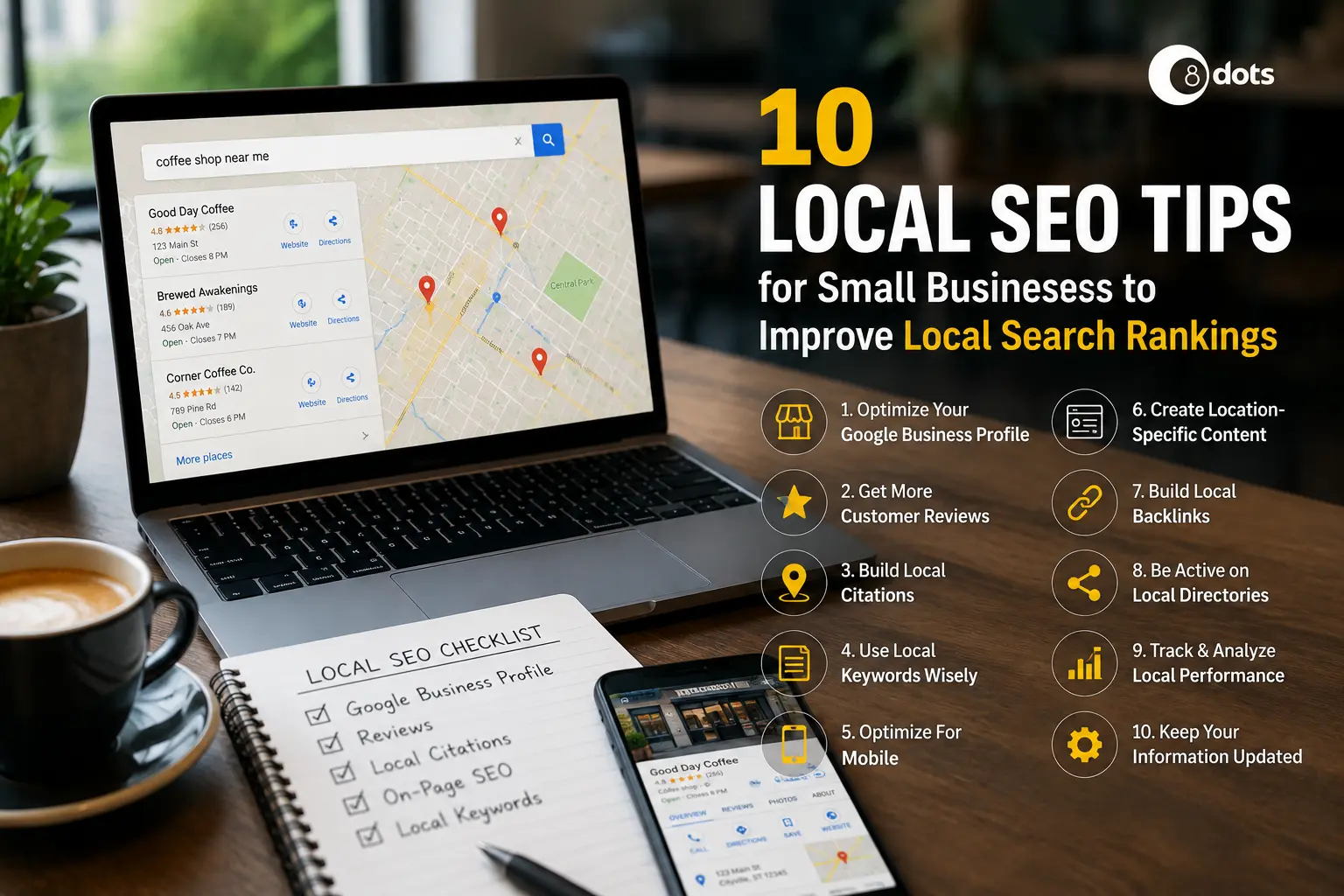
When people need a nearby restaurant, plumber, dentist, salon, or digital marketing agency, they usually turn to Google Search or Google Maps. They search using phrases like “near me” or include their city name to find businesses that can help them right away. If your business doesn’t appear in those local search results, you’re likely missing out on valuable customers.
That’s where Local SEO (Local Search Engine Optimization) comes in. Local SEO helps your business appear in search results when people in your area are looking for the products or services you offer. It focuses on improving your online presence so potential customers can easily discover your business, learn about it, and contact you.
In this guide, you’ll learn 10 practical Local SEO tips that can help improve your local search rankings, attract more nearby customers, and grow your small business.
What Is Local SEO and Why Does It Matter?
Local SEO is the process of optimizing your online presence so your business appears in local search results. Unlike traditional SEO, which targets a broad audience, Local SEO focuses on reaching customers in specific cities, neighborhoods, or service areas.
For example, if someone searches “best coffee shop in Ahmedabad” or “electrician near me,” Google shows businesses that are most relevant to that location. Local SEO helps your business become one of those results.
How Local SEO Connects Customers with Your Business
Every day, thousands of people search online before making a purchase or booking a service. Google considers factors such as your location, business information, reviews, and website quality to determine which businesses to display.
When your Local SEO is well optimized, customers can:
- Find your business faster.
- View your contact details instantly.
- Get directions through Google Maps.
- Read customer reviews.
- Visit your website or call your business directly.
This makes it easier for nearby customers to choose your business over competitors.
Local SEO offers several advantages for small businesses, including increased visibility, qualified leads, and higher conversion rates. According to Google, 76% of people who search for something nearby on their smartphone visit a related business within a day, and 28% of those searches result in a purchase. This highlights how strong local visibility can directly drive foot traffic and sales.
How Does Local SEO Work?
Google wants to show users the most relevant local businesses for every search. To decide which businesses appear in local results, Google evaluates several ranking signals.
Understanding these factors helps you focus your SEO efforts where they matter most.
Google’s Three Local Ranking Factors: Relevance, Distance, and Prominence
Google mainly uses three factors to rank local businesses:
Relevance
This measures how closely your business matches the user’s search. Complete business information, accurate categories, and relevant website content improve relevance.
Distance
Google considers how close your business is to the searcher’s location or the location included in the search query.
Prominence
Prominence reflects your business’s reputation online. Customer reviews, backlinks, business citations, website authority, and overall brand recognition all contribute to this factor.
Businesses that perform well in these three areas have a greater chance of appearing in Google’s Local Pack and Maps results.
Tip 1: Optimize Your Google Business Profile
Your Google Business Profile is one of the most important ranking factors in Local SEO. A fully optimized profile improves your visibility in Google Search and Maps while giving customers the information they need to contact or visit your business.
Complete Every Section
Fill out every available field, including:
- Business name
- Address
- Phone number
- Website
- Business hours
- Services
- Products
- Business description
- Service areas
The more complete your profile is, the easier it is for Google to understand your business.
Choose the Right Business Categories
Select the category that best describes your primary business. You can also add secondary categories if they accurately represent additional services.
Choosing the correct categories helps Google display your business for the right searches.
Upload High-Quality Photos That Build Trust
Photos make your business more attractive and trustworthy.
Upload images of:
- Your storefront
- Office or workspace
- Team members
- Products
- Services in action
Regularly updating photos also signals that your business is active.
Tip 2: Keep Your Business Information Consistent Everywhere
Your business information should be identical across every online platform. Even small differences can confuse search engines and reduce your local rankings.
Why NAP Consistency Matters
NAP stands for:
- Name
- Address
- Phone Number
For example:
If your website lists:
8 Dots Digital Marketing
but another directory lists:
Eight Dots Marketing
Google may see these as different businesses.
Always keep your NAP exactly the same across:
- Your website
- Google Business Profile
- Yelp
- Justdial
- IndiaMART
- Other local directories
Consistency strengthens Google’s confidence in your business information.
Fix Common Listing Errors
Regularly audit your business listings for issues like:
- Old phone numbers
- Incorrect addresses
- Duplicate listings
- Outdated business hours
- Broken website links
Keeping your listings updated improves both customer experience and search visibility.
Tip 3: Build Trust with Customer Reviews
Customer reviews are one of the strongest trust signals in Local SEO. Positive reviews not only influence purchasing decisions but also improve your chances of appearing higher in local search results.
Why Reviews Influence Rankings
Google values businesses that consistently receive genuine customer feedback.
Businesses with more positive reviews often experience:
- Better local rankings
- Higher click-through rates
- Increased customer trust
- More inquiries and sales
Quality matters just as much as quantity, so focus on collecting honest reviews from satisfied customers.
Best Ways to Get More Reviews
Make leaving a review simple.
You can:
- Share your Google review link after every completed service.
- Ask customers through email or WhatsApp.
- Display a QR code in your store.
- Politely request feedback after a positive customer interaction.
Never buy fake reviews or offer incentives that violate Google’s guidelines.
Respond Professionally to Every Review
Always respond to reviews, whether they are positive or negative.
For positive reviews:
- Thank the customer.
- Mention the service they used.
- Invite them to return.
For negative reviews:
- Stay calm.
- Acknowledge the issue.
- Offer a solution.
- Continue the conversation privately when appropriate.
Professional responses show future customers that you care about their experience.
Tip 4: Optimize Your Website for Local Search
Your website plays an important role in Local SEO. Even if your Google Business Profile is fully optimized, your website helps Google understand your expertise and location.
Use Local Keywords Naturally
Include your city, neighborhood, or service area naturally within:
- Page titles
- Headings
- Meta descriptions
- Website copy
- Image alt text
For example:
- Website Designer in Ahmedabad
- Family Dentist in Pune
- Home Cleaning Services in Mumbai
Avoid keyword stuffing. Write for people first and search engines second.
Create Dedicated Location Pages
If you serve multiple cities, create individual pages for each location instead of trying to target every city on one page.
Each page should contain:
- Unique content
- Local customer testimonials
- Area-specific services
- Contact information
- Google Map embedding
This helps each location rank independently.
Improve Mobile Speed and User Experience
Most local searches happen on smartphones.
Your website should:
- Load quickly.
- Display correctly on every device.
- Have clickable phone numbers.
- Include easy navigation.
- Feature clear call-to-action buttons.
A smooth mobile experience keeps visitors engaged and increases conversions.
Tip 5: Strengthen Your Local Authority
Google trusts businesses that have a strong online reputation. Building local authority through citations and backlinks can significantly improve your local search rankings.
Build Accurate Local Citations
A local citation is any online mention of your business’s name, address, and phone number.
Create or update listings on trusted platforms such as:
- Google Business Profile
- Bing Places
- Apple Maps
- Justdial
- IndiaMART
- Sulekha
- Yellow Pages
Ensure your information is accurate and consistent across every platform.
Earn High-Quality Local Backlinks
Backlinks from reputable local websites signal trust and authority to Google.
You can earn local backlinks by:
- Partnering with local businesses.
- Sponsoring community events.
- Writing guest articles for local blogs.
- Joining local business associations.
- Getting featured in local news publications.
Focus on earning relevant, high-quality links rather than a large number of low-quality ones.
Tip 6: Create Local Content That Attracts Nearby Customers
Publishing locally relevant content is one of the best ways to improve your visibility in local search results. It helps Google understand where you operate while showing potential customers that you’re familiar with their community and needs.
Instead of writing only about your products or services, create content that answers local questions and provides useful information.
Cover Local Events and Community News
Writing about local events, festivals, business updates, or community activities can help you connect with people in your area.
For example, a restaurant could publish a guide to local food festivals, while a home renovation company might write about seasonal home maintenance tips for homeowners in its city.
This type of content makes your website more relevant to local audiences and can attract visitors searching for location-specific information.
Answer Questions Your Local Customers Ask
Think about the questions customers ask before contacting your business. Turning these questions into blog posts or FAQs helps you target long-tail local keywords while providing valuable information.
Examples include:
- How much does a plumber charge in Ahmedabad?
- Best time to install solar panels in Texas.
- How to choose the right dentist in Pune.
Helpful content builds trust and encourages users to choose your business when they’re ready to make a decision.
Tip 7: Add Local Business Schema Markup
Schema markup is structured data added to your website that helps search engines better understand your business information.
While visitors won’t notice it, search engines use this data to display more detailed information in search results.
What Is Local Business Schema?
Local Business Schema includes important details such as:
- Business name
- Address
- Phone number
- Business hours
- Website
- Geographic location
- Services offered
Adding this information makes it easier for Google to verify your business details.
Benefits of Structured Data
Implementing Local Business Schema can provide several benefits:
- Helps search engines understand your business.
- Supports accurate business information in search results.
- Improves eligibility for rich search features.
- Strengthens your overall Local SEO strategy.
Although schema markup is not a direct ranking factor, it helps search engines interpret your website more effectively.
Tip 8: Monitor Your Local SEO Performance
Local SEO is not a one-time task. Regular monitoring helps you identify what’s working, discover new opportunities, and fix issues before they affect your rankings.
Tracking performance also helps you make data-driven decisions instead of relying on guesswork.
Track Rankings and Google Business Profile Insights
Google Business Profile provides valuable insights, including:
- How customers found your business.
- Search terms people used.
- Calls received.
- Direction requests.
- Website visits.
- Photo views.
Monitoring these metrics helps you understand customer behavior and improve your profile over time.
Measure Website Traffic and Customer Actions
Use tools like Google Analytics 4 (GA4) and Google Search Console to monitor:
- Organic traffic.
- Local keyword rankings.
- Click-through rates.
- Website conversions.
- Indexed pages.
- Search performance.
Review these reports regularly to identify areas that need improvement and measure the success of your Local SEO efforts.
Tip 9: Avoid Common Local SEO Mistakes
Even well-optimized businesses can lose rankings by making avoidable mistakes. Identifying and fixing these issues can improve your local search performance.
Keyword Stuffing in Local Content
Using your target location repeatedly throughout a page doesn’t improve rankings. Instead, it makes your content difficult to read and may hurt user experience.
Focus on writing naturally while using local keywords where they make sense.
Ignoring Mobile Experience
Most local searches happen on mobile devices. A slow or difficult-to-use website can lead visitors to leave before contacting your business.
Ensure your website:
- Loads quickly.
- Is mobile responsive.
- Has easy-to-click buttons.
- Displays contact information clearly.
Neglecting Local Citations and Listings
Many businesses create directory listings once and never update them.
Review your listings regularly to ensure your:
- Address is correct.
- Phone number is current.
- Business hours are accurate.
- Website URL works properly.
Not Updating Your Business Information
If your business changes its location, phone number, or operating hours, update this information across your website, Google Business Profile, and every online directory as soon as possible.
Keeping your information current helps customers and prevents confusion.
Tip 10: Follow a Local SEO Checklist for Ongoing Success
A simple checklist can help you stay consistent with your Local SEO efforts.
Local SEO Checklist
- Optimize your Google Business Profile.
- Keep your Name, Address, and Phone Number consistent across all platforms.
- Choose accurate business categories.
- Collect and respond to customer reviews regularly.
- Use local keywords naturally throughout your website.
- Create dedicated location pages for each service area.
- Make your website mobile-friendly and fast.
- Add Local Business Schema markup.
- Build quality local citations and backlinks.
- Monitor your performance using GA4, Google Search Console, and Google Business Profile Insights.
Review this checklist every few months to keep your Local SEO strategy up to date.
Frequently Asked Questions About Local SEO
How long does Local SEO take to show results?
Most businesses start seeing improvements within three to six months, depending on competition, website quality, and how consistently they apply Local SEO best practices.
Is Google Business Profile enough for Local SEO?
No. A Google Business Profile is essential, but it works best when combined with a well-optimized website, consistent business listings, customer reviews, local content, and quality backlinks.
How many reviews should a small business have?
There’s no fixed number. Instead of focusing on quantity alone, aim to collect genuine reviews regularly and respond to them professionally. Consistent, high-quality reviews build trust with both customers and search engines.
What is the difference between SEO and Local SEO?
SEO focuses on improving visibility in general search results, while Local SEO helps businesses appear in location-based searches on Google Search and Google Maps.
Can Local SEO help service-based businesses?
Yes. Whether you’re a plumber, lawyer, electrician, digital marketing agency, healthcare provider, or consultant, Local SEO helps you reach customers searching for services in your target area.
Conclusion
Local SEO is one of the most effective ways for small businesses to attract nearby customers and grow their online presence. By optimizing your Google Business Profile, maintaining consistent business information, earning customer reviews, improving your website, creating valuable local content, and tracking your performance, you can build a strong foundation for long-term success.
Remember that Local SEO is an ongoing process. Search trends, customer behavior, and Google’s algorithms continue to evolve, so regularly updating your strategy will help you stay competitive and maintain strong local search rankings.
Ready to Grow Your Local Business?
If you want to attract more local customers, rank higher on Google Search and Maps, and build a stronger online presence, 8 Dots is here to help. Our Local SEO experts create customized strategies that improve your visibility, increase qualified traffic, and drive real business growth.
Contact 8 Dots today and let us help your business stand out in local search results.
